


Objective Wound Healing Monitoring: The Critical Role of TEWL and Skin Hydration
Updated: Mar 25
Wound Healing: A Complete Guide to Monitoring Skin Recovery
Wound healing is more than just “the skin closing up.” It’s a complex, multi-stage biological process that restores the skin’s barrier, protects against infection, and ensures tissue strength. Understanding and monitoring this process can prevent complications, speed recovery, and even improve long-term skin function and appearance.
In this guide, we’ll explain each stage of healing, key indicators to watch, and practical ways to track progress safely and effectively.
Stage 1: Hemostasis – Stopping the Bleed
Duration: Immediate (minutes to hours)
The first response to injury is blood clot formation, which seals the wound and prevents fluid loss. Platelets release growth factors that prepare the tissue for repair.
What to look for:
Adequate clot formation
Minimal continued bleeding
No signs of hematoma (blood pooling under the skin)
Why monitoring matters:
Even at this early stage, excess dryness or overly wet conditions can affect clot stability, setting the tone for the entire healing process.
Stage 2: Inflammation – Cleaning and Defending
Duration: 24–72 hours
Inflammation is your body’s way of clearing debris and protecting against infection. Redness, warmth, and mild swelling are normal signs.
Indicators of healthy healing:
Gradual reduction of redness and swelling
Minimal pain
Absence of foul odor or excessive discharge
Why monitoring matters:
Prolonged or excessive inflammation can indicate infection or delayed healing.
Tracking hydration and barrier function ensures the wound environment supports natural repair.
Monitoring tip:
Clinicians increasingly use non-invasive measurements of skin hydration and barrier integrity to detect early issues that may not be visible to the naked eye.
Stage 3: Proliferation – Building New Tissue
Duration: Days 3–21
This is the “construction phase.” The body generates new tissue, blood vessels, and collagen to fill the wound. Granulation tissue appears pink and bumpy, signaling healthy growth.
What to watch for:
Pink, healthy granulation tissue
Gradual wound contraction
Early signs of necrosis or slough
Why monitoring matters:
Proper hydration and barrier function are essential for collagen deposition and tissue strength.
Subtle imbalances in moisture or skin barrier function can slow healing without obvious visual cues.
Tip:
Objective wound healing monitoring can reveal changes in tissue hydration or barrier function, enabling timely interventions before complications develop.
Stage 4: Remodeling (Maturation) – Strengthening the Skin
Duration: Weeks to months
During remodeling, the new tissue becomes stronger and more organized. Scars may fade, but tissue strength and flexibility are critical for long-term skin health.
What to monitor:
Skin elasticity and firmness
Moisture levels to support flexible tissue
Scar formation, both for function and aesthetics
Why monitoring matters:
Dehydration or impaired barrier function can result in fragile tissue or hypertrophic scars.
Long-term wound outcomes depend on careful tracking and intervention even after the wound appears “closed.”
How Objective Monitoring Supports Healing
Traditional wound assessment relies on visual inspection and manual palpation, which can be subjective and inconsistent. Objective monitoring focuses on quantitative data, helping clinicians:
Track transepidermal water loss (TEWL) to ensure the skin barrier is restoring properly
Measure superficial tissue hydration to optimize the wound environment
Detect early signs of delayed healing or complications
For example, tools that measure TEWL and skin moisture are increasingly used in clinical settings to guide evidence-based wound care, ensuring faster, safer recovery.
Why Wound Healing Monitoring Matters for Health
Medical importance: Reduces infection risk, prevents chronic wounds, and avoids systemic complications.
Functional outcomes: Promotes tissue strength, elasticity, and mobility.
Aesthetic benefits: Supports smoother, healthier skin with minimal scarring.
By monitoring wound healing objectively, clinicians can intervene early, adjust care strategies, and improve both short-term recovery and long-term skin health.
Historical Perspective: When Did We Start Caring About Wound Healing?
Interest in wound healing isn’t new:
Ancient civilizations like the Egyptians and Greeks used herbal ointments and bandaging to improve wound recovery.
19th century medicine introduced antisepsis, dramatically reducing infections.
Modern era (20th century onward) emphasizes objective monitoring—measuring parameters like tissue hydration, oxygenation, and barrier function rather than just visual assessment.
Today, technology allows clinicians to quantify healing progress, rather than rely solely on subjective observation.
In clinical practice, devices that measure TEWL and superficial moisture provide valuable insight into wound healing. For instance, some tools allow clinicians to track barrier integrity and hydration objectively, giving patients the best chance for safe, complete recovery.
The Consequences of Not Monitoring Wounds
Failing to monitor wounds goes beyond aesthetics:
Medical implications: Untreated infections, chronic wounds, systemic inflammation, and in severe cases, sepsis.
Functional impairments: Scar contractures can limit mobility.
Delayed interventions: Early signs of poor healing may be subtle; without monitoring, corrective actions are often late.

In other words, wound healing is a critical health parameter, not just a cosmetic concern. Regular monitoring supports both patient safety and quality of life.
Why Wound Healing Monitoring Is Crucial in Cosmetic and Medical Research
Wound healing monitoring is not only essential in clinical care; it is also a cornerstone of cosmetic science and medical research. Whether evaluating a new surgical protocol, a dermatological treatment, or a post-procedure skincare product, researchers rely on objective wound healing data to measure safety, efficacy, and long-term skin health.
Understanding how and why we monitor healing allows clinicians and researchers to move from subjective observation to evidence-based decisions.
1. In Medical Research: Protecting Health and Preventing Complications
In medical settings, wound healing monitoring directly impacts patient safety and clinical outcomes. It Matters because poorly monitored wounds can lead to infection, chronic non-healing wounds, delayed tissue regeneration, excessive scarring, and systemic complications such as sepsis.
In research trials, especially those involving surgery, diabetes, vascular disease, or burns, monitoring wound healing is crucial to determine whether a treatment improves or impairs recovery.
2. In Cosmetic Research: Optimizing Skin Recovery and Results
Cosmetic procedures, from microneedling and laser resurfacing to chemical peels and injectables, intentionally create controlled micro-injuries to stimulate skin regeneration.
In these cases, wound healing monitoring becomes essential to evaluate both safety and performance.
Cosmetic research must answer questions like:
How quickly does the skin barrier recover?
Does the treatment improve long-term hydration?
Does it increase TEWL temporarily?
Does it strengthen tissue structure over time?
Without quantitative monitoring, results are based largely on:
Patient perception
Visual inspection
Photographic comparison
While helpful, these methods lack precision.
3. The Broader Implications: Beyond Aesthetics
It is important to understand that wound healing monitoring is not just about cosmetic outcomes.
It affects infection risk, tissue strength, scar contracture risk, skin elasticity, and long-term barrier resilience.
In medical research, this can mean preventing hospitalization.
In cosmetic research, it can mean preventing adverse reactions and improving patient satisfaction.
In both fields, proper monitoring supports evidence-based innovation, safer treatment protocols, predictable recovery timelines, and improved patient trust.
4. Why Visual Assessment Alone Is Not Enough
Traditionally, wound healing evaluation has relied on color changes, swelling, palpation, and scar appearance. But early barrier dysfunction, hydration imbalance, or subclinical inflammation are often invisible to the naked eye.
That’s why modern wound healing monitoring increasingly includes:
TEWL measurement to assess barrier integrity
Skin hydration measurement to evaluate tissue readiness
Longitudinal data tracking over time
This shift toward quantitative assessment improves both research reliability and clinical decision-making.
5. The Future of Wound Healing Monitoring in Research
As dermatological and medical technologies evolve, research is shifting toward:
Non-invasive monitoring methods
Real-time skin barrier assessment
Data-driven wound recovery tracking
Personalized healing profiles
Objective wound healing monitoring allows researchers to move from “it looks healed” to “it is biologically restored.”
And that distinction is critical.
Objective Wound Healing Monitoring: From Biology to Evidence-Based Skin Assessment
Wound healing monitoring is no longer limited to visual inspection. In modern medical and cosmetic research, it has evolved into a data-driven process grounded in skin barrier science, tissue hydration dynamics, and longitudinal measurement.
To understand why objective monitoring matters, we must first revisit the biology of healing — and then examine how measurable parameters translate into clinical decisions.
Wound healing is a tightly regulated physiological cascade involving cellular signaling, extracellular matrix remodeling, angiogenesis, and barrier restoration. While the process is traditionally divided into four phases, these stages overlap biologically.
At the center of successful healing are two critical functional outcomes:
Restoration of the skin barrier
Re-establishment of optimal tissue hydration
Without both, healing may appear complete on the surface while remaining biologically compromised.
This is why objective wound healing monitoring through TEWL measurement and tissue hydration assessment is essential for tracking skin barrier recovery and improving clinical outcomes.
Why Monitoring Skin Barrier Recovery Is Crucial
The skin barrier prevents microbial invasion, excessive water loss, chemical irritation, and mechanical vulnerability.
After injury, whether surgical, traumatic, or cosmetic, the barrier is disrupted. One of the most reliable ways to assess its recovery is through transepidermal water loss (TEWL) measurement.
When TEWL is elevated, it indicates impaired barrier integrity. As healing progresses, TEWL should gradually decrease toward baseline.
Monitoring TEWL allows clinicians and researchers to:
Quantify barrier disruption after procedures
Detect delayed barrier recovery
Identify subclinical inflammation
Compare treatment protocols objectively
Establish safe cosmetic downtime timelines
In clinical and dermatological research settings, devices such as the VapoMeter® are used to measure TEWL using a closed-chamber method. This approach provides reproducible, non-invasive data that supports longitudinal wound healing assessment.
Rather than asking “Does the wound look healed?”, clinicians can ask: “Has the barrier biologically recovered?”
That distinction is critical and the VapoMeter® helps achieve exactly that.
Objective TEWL Measurement with the VapoMeter® |
VapoMeter® instrument diagonal view VapoMeter® instrument top view VapoMeter® instrument front view VapoMeter® instrument side view
The VapoMeter® is a closed-chamber TEWL measurement device designed to provide reproducible, non-invasive assessment of skin barrier function.
Unlike open-chamber systems, closed-chamber technology:
Prevents environmental interference (airflow, humidity fluctuations)
Enhances Sensitivity for Early Detection
Allows portable, point-of-care measurements
Improves repeatability in longitudinal wound healing studies
Enables faster stabilization of readings
In wound healing monitoring, the VapoMeter® allows clinicians and researchers to:
Quantify the degree of barrier disruption immediately after injury or cosmetic procedures
Track progressive barrier normalization over time
Detect delayed recovery before visible symptoms appear
Compare treatment modalities objectively
Validate post-procedure skincare protocols
For example, in post-surgical research, TEWL may spike immediately after closure. A steady decline toward baseline over subsequent days signals proper barrier restoration. However, persistently elevated TEWL may indicate subclinical inflammation or compromised healing, even if the wound appears superficially closed.
By integrating TEWL measurement into wound healing monitoring protocols, clinicians move from assumption-based evaluation to data-driven skin barrier recovery assessment.
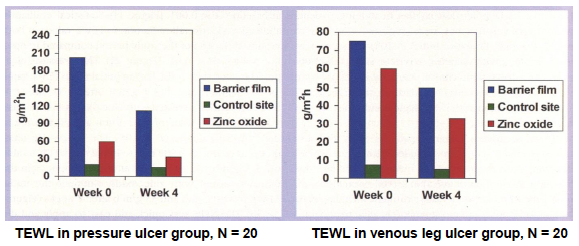
Skin barrier monitoring during treatment
with 2 types of skin protective agents used
on skin surrounding chronic wounds, N = 40
Conclusion: “TEWL measurements are the most important biophysical parameters for evaluating the efficiency of the human skin water barrier”
DiniV, SalibraF, BrilliC and RomanelliM. Instrumentalevaluationoftheprotectiveeffectsofabarrierfilmonsurroundingskininchronicwounds. Wounds2008;20(9):254-257.
This is particularly important in medical wound research, post-surgical outcome studies, cosmetic procedure recovery analysis, and chronic wound management.

While TEWL measures how well the barrier prevents water loss, it does not reveal whether the tissue itself maintains optimal hydration for regeneration.
Effective wound healing requires a balanced moisture environment. Hydration influences:
Keratinocyte migration
Fibroblast activity
Collagen synthesis
Enzymatic remodeling
Scar elasticity
Both extremes can impair healing because excessive dryness can delay epithelialization and increase tissue fragility, and moisture excess can cause maceration and increase bacterial proliferation.
This makes hydration monitoring a second essential pillar of objective wound healing monitoring.
Quantifying Superficial Skin Hydration with the MoistureMeterSC™ |
MoistureMeterSC diagonal view MoistureMeterSC front view MoistureMeterSC top view
The MoistureMeterSC™ measures superficial skin water content using dielectric constant technology. This method quantifies tissue hydration levels non-invasively and provides immediate numerical values.
In wound healing monitoring, superficial hydration data helps clinicians:
Identify dehydration in newly healed skin after wound healing
Prevent maceration in exudative wounds
Evaluate the impact of occlusive dressings
Optimize topical product selection
Predict scar quality and long-term tissue resilience
For example, after laser resurfacing, hydration levels may fluctuate significantly. While TEWL may show improving barrier integrity, insufficient superficial hydration could impair collagen remodeling. On the other hand, excessive moisture under occlusion may increase complication risk.
By measuring hydration objectively, clinicians can fine-tune:
Dressing selection
Frequency of application of moisturizers
Use of barrier-supporting formulations
Timing of intervention adjustments
When integrated into clinical research protocols, hydration measurement strengthens the reliability of cosmetic procedure recovery studies and chronic wound investigations.

Comprehensive wound healing monitoring requires assessment of both barrier integrity (TEWL measurement) and tissue hydration status.
Because the VapoMeter® and MoistureMeterSC™ are compact, lightweight instruments, they can be used in any position and on virtually any part of the body, enabling flexible and precise monitoring of skin barrier recovery and tissue hydration in both clinical and research settings.
The VapoMeter® provides insight into how effectively the skin prevents water loss, a direct indicator of barrier restoration.
The MoistureMeterSC™ provides insight into the internal hydration state of superficial tissue — a determinant of regenerative readiness.
Together, they allow clinicians and researchers to evaluate:
Biological healing versus visual closure
Functional recovery versus cosmetic appearance
Subclinical dysfunction before complications arise
Personalized healing trajectories
In modern dermatologic research, cosmetic studies, and medical wound care, this dual-parameter approach represents a shift toward objective, evidence-based wound healing monitoring that improves skin barrier recovery, tissue hydration assessment, and overall clinical and aesthetic outcomes.

Evidence-based wound healing starts here:
TEWL and hydration assessment in one dual approach.
Discover Delfin’s full range of skin research Instruments at Skinlabs and see how advanced measurement tools can elevate your next research. |
PUBLICATIONS |
While few studies have applied the VapoMeter® and MoistureMeterSC™ specifically in wound healing trials, these instruments have been widely validated in clinical research to measure TEWL and superficial skin hydration, the key parameters that underpin objective wound healing monitoring.
For example, clinical studies have used the VapoMeter® for accurate closed‑chamber TEWL assessment and the MoistureMeterSC™ for quantifying tissue hydration, providing reproducible and scientifically validated data for skin barrier recovery and regeneration.
HONG KONG MEDICAL JOURNAL
Hon, Ellis Kam Lun & Pok, Hyga & Ng, WGG & Kung, Charmaine & Cheng, NS & Lin, Zhi-xiu & Chow, Chi-Ming & Leung, Ting F.. (2020). Age, sex, and disease status as determinants of skin hydration and transepidermal water loss among children with and without eczema. Hong Kong Medical Journal. 26. 10.12809/hkmj198150.
J-STAGE
Hasegawa Tsuyoshi, Examination of the influence of advanced end products on the development of skin tears: A cross-sectional study comparing the incidence and non-incidence groups in elderly people at high risk of skin tears, Journal of the Japanese Society of Wound, Ostomy and Continence Management, 2024, Vol. 25, No. 1, pp 38-48, Published 2024/07/31, Online ISSN 1884-2321, Print ISSN 1884-233X, https://doi.org/10.32201/jpnwocm.28.1_38, https://www.jstage.jst.go.jp/article/jpnwocm/28/1/28_38/_article/-char
Aich B, Kumbhar P, Muchhala S, Sanghavi A, Katare S, Kotak B. Clinical evaluation of a topical ceramide lotion on skin hydration and skin barrier in healthy volunteers with dry skin. CosmoDerma. 2021;4(148). doi: 10.25259/CSDM_175_2024
Microorganisms
Sivamani RK, Maloh J, Nong Y. Correlating the Gut Microbiota and Circulating Hormones with Acne Lesion Counts and Skin Biophysical Features. Microorganisms. 2023: 11(8):2049. https://doi.org/10.3390/microorganisms11082049


Comments