


%20Presentation%202026%20v_edited.png)


Unlock Skin’s Shine: The Power of Skin Gloss Measurement with Delfin’s SkinGlossMeter™
- Emma Danciu
- Dec 1, 2025
- 5 min read
Updated: Jan 21
The Science and Story Behind Skin Gloss: More Than Just Shine
When we talk about radiant skin, “gloss” often comes to mind—but skin gloss is more than just a cosmetic effect. It’s a measurable characteristic that reveals insights into skin health, hydration, and surface properties. Understanding it requires exploring its origins, significance, and practical applications.
Skin gloss originates from the way light interacts with the outermost layer of the skin—the stratum corneum. Smooth, hydrated skin reflects light more uniformly, creating a subtle shine.
Over time, the concept of measuring skin’s reflective properties became important in cosmetic science. Early studies in the 20th century focused on visual appeal, but today researchers use quantitative methods to link gloss with hydration, skin texture, and product efficacy.
Studying skin gloss matters because it is the Indicator of Skin Hydration: Skin that retains moisture appears glossier, making gloss a non-invasive marker of hydration. It Assesses Skin Health: Changes in gloss can reflect aging, environmental damage, or dermatologic conditions. It gives Objective Product Evaluation: Cosmetic and dermocosmetic formulations can be evaluated scientifically, instead of relying solely on subjective impressions.
And finally, it Enhances Consumer Experience: Gloss correlates with perceived youthfulness and radiance, influencing product appeal and satisfaction.
Why gloss is not just about oiliness?
For several reasons: 1. Hydration alone can increase shine without adding excess sebum, humans are naturally drawn to glossier skin; 2. Studies suggest that perceived skin shine can influence attractiveness ratings, and 3. Some high-end cosmetic studies even measure “micro-gloss patterns” across different facial areas to detect subtle differences in hydration or product effect.
Discover how the SkinGlossMeter™ can help your studies today. |


Traditionally, gloss was a subjective observation—we just “saw” whether skin looked shiny. Today, instruments like Delfin’s SkinGlossMeter™ transform gloss into quantitative data, allowing researchers to measure:
Gloss intensity
Surface uniformity
Changes after treatments or product application
This evolution from subjective observation to data-driven insight ensures that cosmetic and dermocosmetic research is reproducible, reliable, and scientifically sound.
Key Advantages of the SkinGlossMeter™
Unlike other devices on the market, the SkinGlossMeter™ measures only specular reflection from the skin or the nails (not diffuse/scattered light). This is important because gloss (shine) is technically defined by that mirror-like reflection. By focusing only on specular reflection, the SkinGlossMeter™ ensures the measurements closely align with the true optical definition of gloss.
In contrast, other devices also measure diffuse scattering, which means their gloss values are influenced by light scattered into the sensor. This difference means the SkinGlossMeter™ gloss readings may be more “pure” gloss, less contaminated by skin color / texture effects.
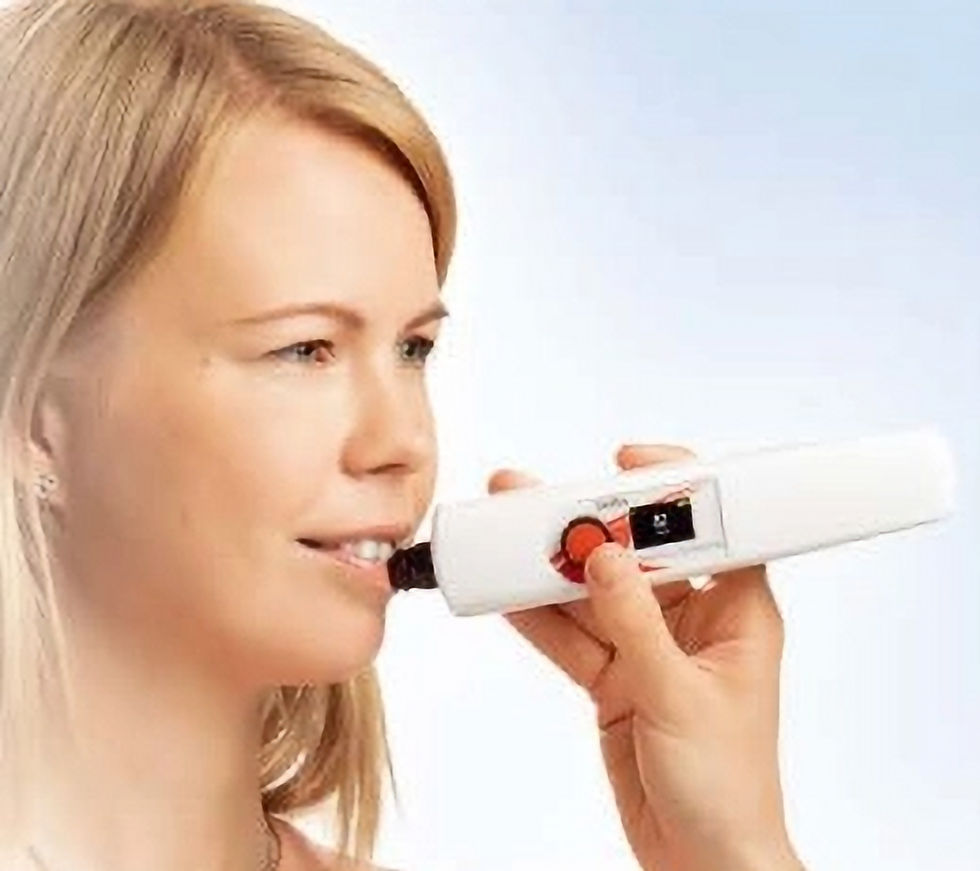
The SkinGlossMeter™ is fully portable, battery-powered, and wireless, allowing direct skin contact measurements even on difficult or non-flat areas such as lips or curved surfaces, like nails.
Many traditional gloss meters require a fixed bench setup or wired probes, but Delfin’s instrument offers greater flexibility for in vivo or field measurements.
Additionally, the laser power is optimized (< 1 mW) to ensure safety while still delivering a clean specular reflection for reliable, repeatable measurements.
Technically advanced, the SkinGlossMeter™ is equipped with a red laser light source. It uses a 635nm red semiconductor diode laser.
The very small laser spot diameter of 50 µm ensures precise targeting on small or curved regions.
The patented internal diffractive microstructure gives the SkinGlossMeter™ a “super-precise eye” that sees only the shininess of skin, ignoring everything else, which makes the measurements more accurate.
Some other devices use white LED light instead, which may generate more diffuse scattering. Their readings can therefore be affected by skin texture, pores, or fine hairs.

✔️The light beam reflects back at the same angle
as it contacts the measured surface
✔️Patented internal diffractive microstructure
Other major key advantage, compared to others, the SkinGlossMeter™ displays its results in Skin Gloss Units (SGU), which are derived from standard industrial Gloss Units (GU) based on ISO, ASTM, and DIN standards.
This means the SkinGlossMeter™’s readings are more standardized and comparable to industrial gloss metrics — useful for scientific rigor and claim substantiation.

Where the SkinGlossMeter™ Makes an Impact
The SkinGlossMeter™ is a versatile tool with applications spanning research, clinical practice, product development, and consumer insights.
In cosmetic and dermocosmetic research, it enables scientists to quantitatively assess how products such as moisturizers, serums, facial oils, or sunscreens influence skin gloss, helping to optimize formulations for the desired aesthetic effect.
For nail polish manufacturers, measuring nail gloss is essential. The SkinGlossMeter™ provides objective, repeatable data to optimize formulas, ensure batch consistency, validate shine claims, and track durability—turning a subjective “wow factor” into measurable results that build consumer trust.
In dermatology and clinical studies, it allows clinicians to monitor changes in skin properties over time or in response to treatments, providing objective data to support efficacy claims and guide patient care.
For product development and quality assurance, the SkinGlossMeter™ ensures that new formulations deliver consistent results, maintaining both the visual appeal and the health of the skin. It also helps teams refine textures, finishes, and overall product experience.
Furthermore, in marketing and consumer insights, the SkinGlossMeter™ provides reliable, measurable evidence that can substantiate product claims, demonstrating visible improvements in skin appearance and helping brands build credibility and consumer trust.
Its ability to deliver precise, reproducible measurements on difficult or curved skin areas, such as lips, facial contours or nails, makes it particularly valuable for in vivo studies and real-world applications.
With precision and insights, the SkinGlossMeter™ offers precise, reproducible skin gloss measurements, making it an essential tool for cosmetic and dermocosmetic research, dermatology studies, product development, and consumer insights.
Its portable, wireless design allows accurate readings, while its advanced optical technology ensures safe and reliable results.
By turning skin shine into measurable data, the SkinGlossMeter™ helps brands, clinicians, and researchers validate product efficacy, optimize formulations, and enhance consumer trust—making it the go-to Instrument for objective skin gloss analysis.
Gloss isn’t just shine—it’s science you can see.

Discover Delfin’s full range of skin research Instruments at Skinlabs and see how advanced measurement tools can elevate your next research. |
Publications
Journal Of Cosmetic Dermatology
Thanawala S, Shah R, Alluri KV, Bhupathiraju K, Salvi A. Efficacy and Safety of an Oral Low-Dose Water-Dispersible Turmeric Extract Capsule on Facial Skin Health in Healthy Women: A Randomized, Double-Blind, Placebo-Controlled Trial. J Cosmet Dermatol. 2025 Sep;24(9):e70462. doi: 10.1111/jocd.70462. PMID: 40971325; PMCID: PMC12448269.
in vivo
Shu-Yi Zhou, Do Min Kang, Yeong Ju Gu, Xin Rui Zhang, Dong Kong Yon, Byung Ho Shin, Jung Ryul Ham, Won Ku Lee, Je Geun Jeong, Han Jin Kwon, Chanyeong, Heo. Bio-characteristics and Efficacy Analysis of Biodegradable Poly Dioxanone Dermal Filler in a Mouse Model and Humans.
In Vivo May 2023, 37 (3) 1093-1102; DOI: 10.21873/invivo.13184
Society for Imaging Science and Technology
Jing Wang, Thrasyvoulos N. Pappas; Northwestern University; Evanston, IL/US Jim Mayne, Carla Kuesten, Gopa Majmudar; Amway; Ada, MI/US. Determining the Influence of Image-based Cues on Human Skin Gloss Perception.
Journal Of Cosmetic Dermatology
Park JY, Youn C, Lee C, Lee KC, Shin H, Yeom KB, Park J, Jung S, Kim JH, Hong W. Facial Skin Quality Improvement After Treatment With CPM-HA20G: Clinical Experience in Korea. J Cosmet Dermatol. 2025 Jan; 24(1) :e16795. doi: 10.111/jocd.16795.
PMID: 39844659; PMCID: PMC11755000.



Comments